Page 14 - BackToSchool2018
P. 14
14C — EL DORADO NEWS-TIMES
List: Continued from Page 13C
YOCUM PRIMARY SCHOOL
Jessica Moore
Asst Principal Email: jmoore@esd-15.org
FOOD SERVICES
715 West Wesson St El Dorado, AR 71730 Tel: 870-864-5134
Fax: 870-864-5134
Grace George
Food Service Director Email: Ggeorge@esd-15.org
ATHLETIC OFFICE
T.A.C. House
1101 Northwest Avenue El Dorado, AR 71730 Tel: 870-864-5002
Fax: 870-864-5002
Phillip Lansdell
Athletic Director
Email: Plansdell@esd-15.org
Monday, August 6, 2018
COUNSELORS Amy Williams
awilliams@esd-15.org
Kimberly Thomas
kthomas@esd-15.org
Nancy Watson
nwatson@esd-15.org
Barbara Williams
Guidance Office Secretary bwilliams@esd-15.org
Helpful links
Phone Number 870-864-5113
File Photo
https://www.eldoradopublicschools.org; Download the El Dorado School District app at Google Play or the iTunes App Store to stay up to date; All El Dorado schools are active on Facebook.
Photo courtesy of El Dorado School District
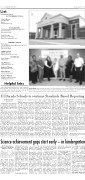
School board: Board meetings are held on the second Monday of each month at the Administration Office Board Room, pictured, from left to right are board members Shaneil "PJ" Yarbrough, Todd Whatley, Vice President Renee Skinner, President Susan Turbeville, past President Wayne Gibson, Vicky Dobson and Keith Smith.
El Dorado Schools to continue Standards Based Reporting
By Michael Shine
Staff Writer
The El Dorado School District is continuing to implement the Standards Based Reporting (SBR) method of grading with students going into second grade.
SBR doesn’t use the grading system most people are used to, but rather scores of one, two or three. The district sets different standards for each grade level with the goal at the end of the school year for students to be scoring a three on every standard.
“What do grades tell us? If a child’s got an 85 percent, we think that well that’s probably pretty good,” said Tom Simmons, District Math Chair. “But it didn’t do a very good job of telling the story of exactly what the student had mastered and what they hadn’t mastered. You could be a B student for a lot of different reasons. You could be an A
student for a lot of different reasons.”
With the SBR form of grading, the report cards sent home every nine weeks are broken down to show the different standards for that year. Not every standard is assessed every nine weeks, and once a student achieves a three they’re not assessed again. However, they’re all on each report card.
Students are given assessments to test each of the standards, but that is the only grades they’re given over the course of the year.
“I think this is one of the great advantages of using this system,” said Jeannie Strother, District Literacy Chair. “You don’t see that (test anxiety) because they’re really being assessed informally. With that formal assessment, the students don’t even necessarily know that it’s a test.”
First grade standards for math include goals such as counting to 120, add and subtract within
20, be able to tell and write time, and complete word problems whose sum is less than 20. Meanwhile for literacy, students are expected to recall key details from stories, use singular and plural nouns to match verbs, and use proper capitalization.
While the goal is for all students to reach a three for every standard, when a student moves to the next grade level their new teacher will get their last report card to be able to address any areas where the student was still scoring a two.
“Learning take place continuously in a lot of schools,” Simmons said. “Instruction’s a little bit different in that respect. Then the teacher monitors daily so students become more and more proficient."
When looking at implementing this system at El Dorado, Assistant Superintendent Ronda Simmons and other local educators visited other
districts such as Warren and Bryant to get an idea of how the system could work.
It is currently being implemented throughout the elementary schools in the district. A group of students were introduced to it when they started kindergarten and the process has been following that group as they move up through the system.
The system is still developing and changing with input from teachers who are actively teaching using the system. While the standards typically won’t change during a year, teachers from each grade level meet four times a year to give reports on successes and struggles with the program.
“Their (teacher) input has been very valuable to us moving forward and even in the course of a year,” Strother said. “As we’re looking at something, if they feel that we don’t need to do this particular assessment, we need to do something else,
then they know through their formative assessments that they’re ready for something then we’ll try to come up with something else. It’s ongoing and it is fluid.”
As students continue to move up through the school system, administrators are still working on figuring out how the system would work in high school or with college applications.
“I think it depends on how for we continue to go with Standards Based Reporting,” Strother said. “To my knowledge, that hasn’t been decided. Because we’re still new into it, we really look at how well it really is at marking where we are. What becomes really difficult is making those assessments that test only one standard. We’ll just have to see how we shift that and how far we take that up.”
Michael Shine may be reached at mshine@eldoradonews.com or 870-862-6611.
Science achievement gaps start early
– in kindergarten
By F. Chris Curran, University of Maryland,
Baltimore County
Editor’s note: The Conversation is an independent and nonprofit source of news, analysis and commentary from academic experts.
The annual back-to- school season is filled with high hopes for making new friends, meeting new teachers – and, from the view of many policymakers – promoting gains in science achievement. Scientific learning and research carry substantial economic benefits.
Historically, however, not all groups have excelled in science equally. Black and Hispanic individuals as well as women have been less likely to enter or persist in science-related studies or occupations.
These gaps have been well-studied at the level of high school and higher education. These gaps, however, actually start much earlier.
My research found that these gaps exist at the level of kindergarten. However, these gaps can also change significantly in the first two years of schooling.
Large gaps in science
In a 2016 study, my research assistant, Ann Kellogg, and I examined the science performance of over 10,000 kindergarten students who began school in 2010. We analyzed data from a national study called the Early Childhood Longitudinal Study (ECLS-K) conducted by the federal government.
The data included science achievement tests that assessed concepts in physical, life and environmental science as well as scientific inquiry. Examples of science instruction in kindergarten includes studying how plants
grow, experimenting with erosion on a water table or constructing a picture of the solar system.
Previous research had examined science gaps in early grades. Our study, however, looked at science gaps as early as kindergarten with newer data and better science achievement tests.
Our study revealed large gaps in science achievement in kindergarten between white students and racial or ethnic minorities. And, where science gaps existed, we found that they were generally larger than the gaps in reading or mathematics
achievement. However, we did not find significant gaps by gender.
Achievement gaps are not stagnant
On average, black students and Hispanic students performed significantly lower than white students on the science achievement tests in kindergarten. Approximately 41 percent of black students and 49 percent of Hispanic students scored in the bottom 25 percent. In comparison, only 12 percent of white students were in this category.
The difference in science achievement between
black or Hispanic students and white students is roughly equivalent to what an average elementary student learns over a period of nine months between kindergarten and the end of first grade. The gaps between black, Hispanic and white students might be expected given similar gaps in mathematics and reading.
What surprised us was that Asian students in our study performed significantly lower than white students in kindergarten on the
See GAPS, Page 15C